
LEXNOIR ATLAS
Afro-Brazilians are central to Brazil’s demographic, cultural and political identity. More than half of the country’s population identifies in the census as preta or parda, categories that Brazilian law groups together as the população negra. Yet the legal history of Black Brazil is also a history of slavery, delayed abolition, racial inequality, organized resistance and an expanding body of constitutional and statutory protections.
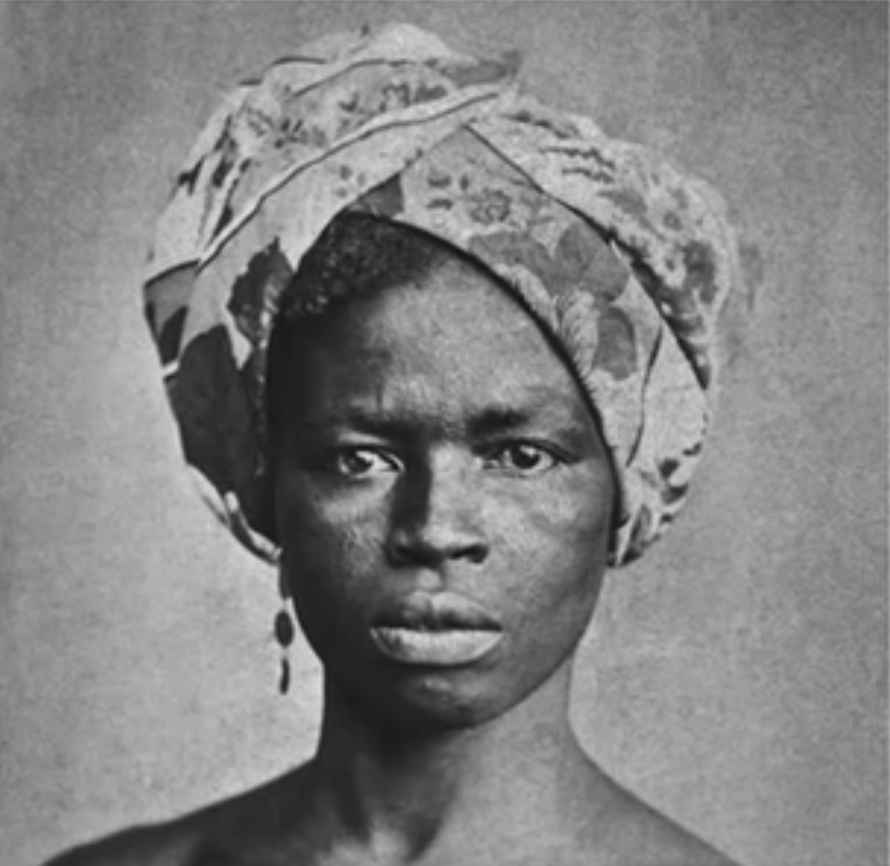
\n\n\nFeatured image: Portrait of a Black woman photographed in Brazil circa 1870 by Alberto Henschel. Wikimedia Commons; public domain.
\nWho Are Afro-Brazilians?
Afro-Brazilian is a broad cultural and historical term rather than a single official census category. Brazil’s national statistical agency, IBGE, asks people to self-identify by color or race using five principal categories: branca (white), preta (Black), parda (brown or mixed), amarela (Asian) and indígena (Indigenous).
Brazilian equality law uses an additional legal-policy concept: the população negra. The 2010 Racial Equality Statute defines that population as people who self-identify as pretos or pardos, or who use an analogous self-definition. That distinction matters. “Afro-Brazilian,” “Black,” preto, pardo and população negra overlap, but they do not always mean precisely the same thing in cultural, political, statistical and legal settings.
The Demographic Scale
Brazil’s 2022 Census counted approximately 92.1 million people identifying as parda and 20.7 million as preta. Together, those groups represented about 55.5% of Brazil’s population. For the first time since 1991, parda was the largest single census category in the country.
The national numbers also conceal significant regional variation. The Northeast has the country’s highest proportion of people identifying as preta, while the North has particularly high proportions identifying as parda. Afro-Brazilian identity is therefore national in scale but expressed through highly diverse regional histories and communities.
A History Shaped by Slavery and Resistance
Brazil received millions of forcibly transported Africans during the transatlantic slave trade. Enslaved Africans and their descendants worked across sugar production, mining, coffee cultivation, urban trades, domestic labor and other parts of the colonial and imperial economy.
Black Brazilian history is also a history of resistance. Enslaved and free African-descended people formed communities, preserved and transformed religious and cultural traditions, built mutual-aid institutions, organized politically and resisted enslavement in numerous ways. Quilombos—communities associated historically with resistance to slavery and, in modern law, with distinctive Afro-Brazilian communities and territorial rights—became enduring symbols of that resistance.
Brazil formally abolished slavery through the Lei Áurea on May 13, 1888. The law was remarkably short: it ended legal slavery but did not create a comprehensive program of land redistribution, economic compensation, education or social integration for the formerly enslaved population. The inequalities that followed abolition therefore became a defining feature of Brazil’s modern racial history.
From Formal Equality to an Anti-Racism Framework
Brazil’s 1988 Constitution marked a major legal turning point. It constitutionalized equality, made racism a crime subject to particularly serious treatment, and recognized territorial rights of remaining quilombo communities through Article 68 of the Transitional Constitutional Provisions.
Over time, Brazil developed a broader statutory framework addressing racial discrimination and inequality. A central instrument is the Racial Equality Statute—Law No. 12,288 of 2010—which seeks to guarantee equal opportunities, defend individual and collective ethnic rights and combat racial discrimination and intolerance.
The Statute is significant because it moves beyond a purely formal prohibition of discrimination. It expressly recognizes racial inequality as a public-policy problem and provides a framework for affirmative action and equality measures in areas including health, education, culture, employment, land, media and access to justice.
Affirmative Action and Education
Brazil has become one of the world’s most important laboratories for race-conscious affirmative action outside the United States.
Federal higher-education policy reserves places for students from public schools and distributes part of those reserved places among self-declared pretos, pardos, Indigenous people and quilombolas in proportions tied to the population of the state where the institution is located. Congress revised the federal quota framework in 2023, expressly retaining and updating racial and social inclusion measures.
Affirmative action has also extended into public employment. A 2025 federal law now reserves 30% of vacancies in covered federal public competitions and certain selection processes for people who are pretas or pardas, Indigenous or quilombola. Federal regulations allocate 25% specifically to pretos and pardos, 3% to Indigenous candidates and 2% to quilombola candidates.
These policies reflect an important feature of Brazilian racial-equality law: the state does not treat discrimination only as an individual wrong. It also uses targeted public policy to address patterns of exclusion and underrepresentation.
Quilombola Rights
Quilombola communities occupy a distinct place within the broader Afro-Brazilian experience. The 1988 Constitution recognizes property rights for surviving quilombo communities, and subsequent law and policy have developed procedures concerning community recognition and collective territory.
The 2022 Census was the first Brazilian national census to count the quilombola population directly, identifying approximately 1.33 million quilombola people. Their legal experience raises questions that overlap with—but are not identical to—the broader racial-equality agenda, including collective land rights, environmental protection, infrastructure, health, education and cultural preservation.
Because those issues are substantial enough to warrant separate treatment, LexNoir Atlas will address quilombola communities in a dedicated profile.
Culture, Religion and National Identity
African-descended communities have profoundly shaped Brazilian culture. Afro-Brazilian influence is visible in music, language, cuisine, dance, religious traditions, literature, visual art, festivals and popular culture. Samba, capoeira and Afro-Brazilian religious traditions such as Candomblé are among the most internationally recognizable expressions, but the cultural influence extends much further.
\n\n\n
This cultural centrality creates an important tension within Brazil’s racial history: Black culture has often been celebrated as foundational to national identity even while Black Brazilians have continued to experience unequal access to wealth, institutional power and personal security.
Contemporary Equality Issues
Brazil now possesses a sophisticated legal and policy architecture for racial equality, but significant disparities remain. Government data continue to document racial gaps across income, employment, education, health, housing, public leadership and exposure to violence.
Violence is particularly stark. Brazil’s 2026 Atlas da Violência reported that 32,820 Black people were victims of homicide in 2024 and that the homicide rate for the Black population remained substantially higher than for the non-Black population. These disparities have made public security, policing and criminal justice central components of the contemporary racial-equality debate.
Other major questions include the implementation and design of affirmative-action programs, verification of racial self-identification in quota systems, political and corporate representation, racial inequality in the labor market, religious intolerance directed at Afro-Brazilian traditions, and the relationship between race, gender and economic inequality.
Institutions and Community Infrastructure
Brazil’s contemporary racial-equality infrastructure spans government agencies, courts, universities, Black social movements, cultural institutions, quilombola organizations and civil-society groups. At the federal level, the Ministry of Racial Equality coordinates policy and maintains public data initiatives devoted to racial disparities.
Brazil also has a long tradition of Black political and civic organization, from early Black associations and newspapers to the modern Black Movement. These institutions have been central to securing recognition of racism as a structural public issue and to the development of affirmative action, cultural protections and broader equality policies.
Why Afro-Brazil Matters to the Global Diaspora
Brazil is indispensable to any serious understanding of the African diaspora. Its African-descended population is among the largest in the world, and its experience provides a distinctive comparative model for examining how societies classify race, remember slavery and design legal responses to persistent inequality.
Brazil also complicates comparisons built around U.S. racial categories. Its system of preto, pardo and other classifications, together with its concept of população negra, demonstrates how race can be socially and legally organized differently while still producing measurable patterns of racial inequality.
For the broader diaspora, Brazil therefore offers several important comparative questions: How should law identify the beneficiaries of racial-equality measures? When is formal equality insufficient? How should affirmative action respond to both race and class? And how can constitutional recognition, public data and collective organization translate into institutional power?
Atlas Perspective
Brazil’s legal trajectory has moved from abolition without comprehensive inclusion, to constitutional equality, to an increasingly explicit effort to confront racial inequality through affirmative action and targeted public policy.
The central question today is therefore not whether Brazil recognizes racial inequality in law. It does. The harder question is whether a large and increasingly sophisticated equality framework can close persistent gaps in security, wealth, education, representation and institutional power.
Further Reading and Primary Sources
IBGE — 2022 Census: Ethnic-Racial Identification
Brazil — Law No. 12,288/2010, Racial Equality Statute
Brazil — Law No. 14,723/2023, Federal Education Quotas
Brazil — Law No. 15,142/2025, Federal Public-Service Quotas
Brazil — Decree No. 12,536/2025, Federal Public-Service Quota Regulation
Brazilian Senate — Lei Áurea, Law No. 3,353/1888
Ministry of Racial Equality — Racial Equality Indicators Platform