
LEXNOIR ATLAS
African American history is central to the history of the United States. It begins with forced migration and slavery, but it does not end there. African Americans built institutions, fought for citizenship, reshaped constitutional law, transformed American culture and politics, and repeatedly forced the country to confront the gap between its stated ideals and lived reality. The modern Black population of the United States is broader still, encompassing long-established African American communities as well as Caribbean, African, Afro-Latino and multiracial Black populations.
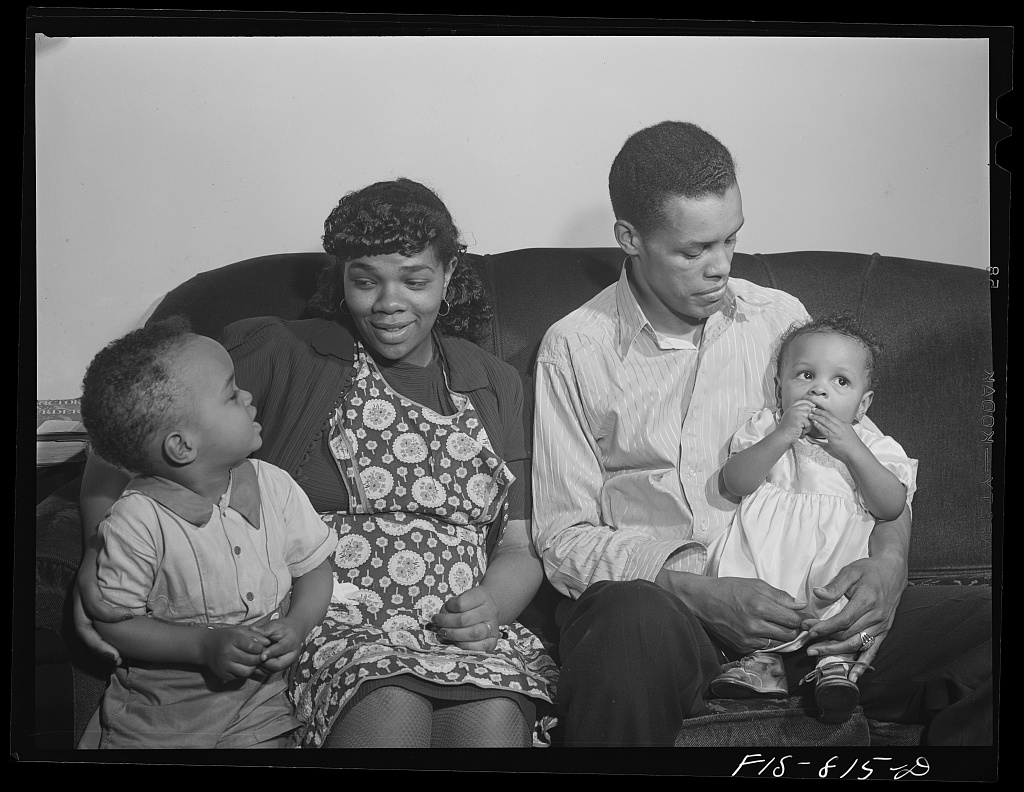
Featured image: African American family at the Ida B. Wells Housing Project, Chicago, 1942. Library of Congress; public-domain U.S. government photograph.
Who Are African Americans?
“African American” most commonly refers to Black Americans whose families have deep historical roots in the United States, especially descendants of people enslaved in the country before emancipation. The term is historically and politically significant, but it does not describe every Black person in the United States.
Today’s Black population also includes immigrants and descendants from the Caribbean, Africa and Latin America, as well as people who identify as multiracial. The 2020 Census counted approximately 41.1 million people as Black or African American alone and about 46.9 million as Black alone or in combination with another race.
Slavery and the Making of the United States
Enslaved Africans and their descendants were foundational to the economic development of the United States. Their labor supported plantation agriculture, shipping, finance, construction, domestic service and other sectors that generated enormous wealth.
Slavery was protected by law and embedded in the constitutional order from the founding era. Even where the Constitution avoided the word “slavery,” provisions concerning representation, fugitive persons and the international slave trade reflected political compromises that preserved the institution.
Resistance, Free Black Communities and Institution Building
Black Americans resisted slavery through escape, rebellion, family preservation, religion, literacy, abolitionism and legal claims. Free Black communities also developed before the Civil War in cities including Philadelphia, Boston, Baltimore, New York and New Orleans.
Churches, mutual-aid societies, newspapers, schools and fraternal organizations became durable institutions of Black civic life. These institutions later provided infrastructure for political organizing, education, business development and the civil-rights movement.
Civil War, Emancipation and Reconstruction
The Civil War destroyed legal slavery but opened a new struggle over citizenship and equality. The Thirteenth Amendment abolished slavery and involuntary servitude except as punishment for crime. The Fourteenth Amendment established national citizenship and equal protection, while the Fifteenth Amendment prohibited denying the vote on account of race.
During Reconstruction, Black men voted and held public office at local, state and federal levels. Black communities founded schools, acquired land where possible, expanded churches and businesses, and participated in rewriting state constitutions.
Reconstruction ended under violent resistance and political retreat. White supremacist organizations, disenfranchisement and state laws systematically stripped away many gains.
Jim Crow and Racial Apartheid
By the late nineteenth century, a system of racial segregation and exclusion known as Jim Crow had taken hold across much of the South. State and local laws segregated schools, transportation, housing and public facilities, while poll taxes, literacy tests, grandfather clauses and violence suppressed Black voting.
The Supreme Court’s 1896 decision in Plessy v. Ferguson constitutionalized “separate but equal,” giving legal sanction to segregation until the doctrine was dismantled in the twentieth century.
The Great Migration
Between the early twentieth century and the 1970s, millions of African Americans left the rural South for cities in the North, Midwest and West. This Great Migration transformed the demographic, political and cultural geography of the United States.
Black communities expanded in cities such as Chicago, Detroit, New York, Philadelphia, Cleveland, Los Angeles and Washington, D.C. Migration created new opportunities but also generated new forms of segregation through restrictive covenants, redlining, discriminatory lending and exclusionary zoning.
The Civil Rights Movement and Federal Law
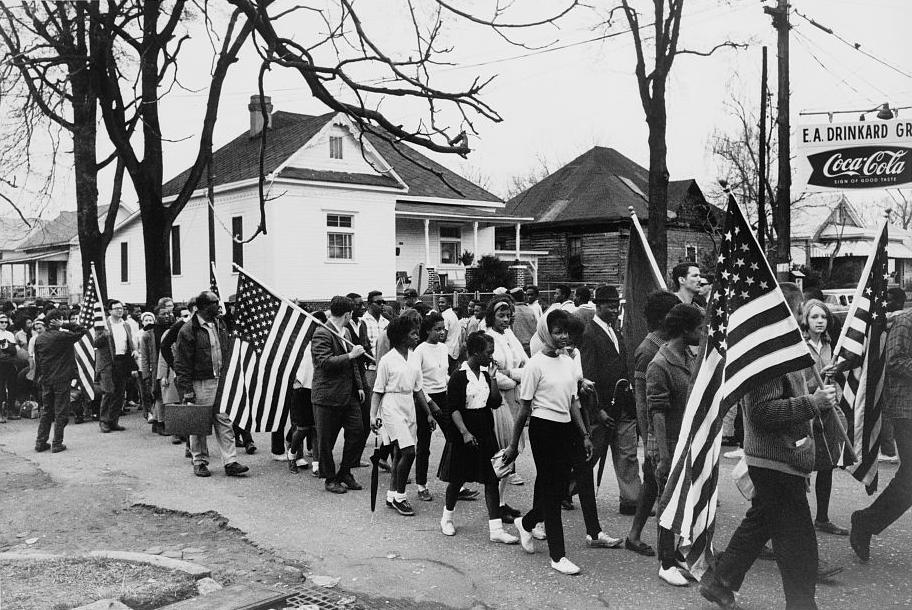
The modern civil-rights movement reshaped American law. Litigation, mass protest, boycotts, sit-ins, freedom rides, voter-registration campaigns and grassroots organizing challenged segregation and exclusion.
Brown v. Board of Education rejected state-mandated school segregation. The Civil Rights Act of 1964 prohibited discrimination in public accommodations, employment and federally funded programs. The Voting Rights Act of 1965 attacked racial barriers to voting, and the Fair Housing Act of 1968 prohibited race discrimination in housing.
These laws did not eliminate racial inequality, but they transformed the legal framework through which discrimination could be challenged.
Voting and Political Power
Voting rights remain one of the most contested areas of African American civic life. The Voting Rights Act dramatically increased Black voter registration and representation, especially in the South.
Later Supreme Court decisions, including Shelby County v. Holder, weakened federal preclearance requirements that had applied to jurisdictions with histories of discrimination. Current disputes involve districting, voter-ID laws, registration rules, felony disenfranchisement and access to early and absentee voting.
Education and Unequal Opportunity
Education has long been both a site of exclusion and a central tool of Black advancement. Historically Black Colleges and Universities became critical institutions for professional training, leadership and community development.
School segregation by law was struck down, but residential segregation, unequal tax bases, school-district boundaries and disciplinary disparities continue to produce unequal educational outcomes in many communities.
Housing, Wealth and the Racial Wealth Gap
Housing policy is one of the clearest examples of how formally neutral rules can preserve historical inequality. Federal and local policies once supported redlining, racially restrictive covenants, urban-renewal projects and mortgage discrimination.
Because homeownership is a major source of household wealth, exclusion from appreciating housing markets had intergenerational consequences. The racial wealth gap reflects differences in income, inheritance, property ownership, business capital and exposure to discriminatory lending and labor markets.
Business, Entrepreneurship and Black Economic Life
Black entrepreneurship has long existed alongside exclusion from mainstream finance and commerce. Historic Black business districts, insurance companies, banks, newspapers, law firms and professional associations created economic infrastructure when segregation limited access to white institutions.
Contemporary Black-owned businesses remain important sources of employment and community investment, but access to capital, procurement and scale continue to be recurring challenges.
Policing, Criminal Justice and the Thirteenth Amendment Exception
Criminal justice is one of the most consequential contemporary civil-rights issues. Black Americans are disproportionately affected by stops, arrests, incarceration and use of force.
The Thirteenth Amendment’s exception for involuntary servitude imposed “as punishment for crime” has also drawn renewed attention because of the historical relationship between emancipation, convict leasing and prison labor.
Modern debates include policing standards, qualified immunity, sentencing, bail, prison conditions, voting rights after conviction and the long-term economic consequences of incarceration.
Culture as a National and Global Force
African American culture has had extraordinary global reach. Spirituals, blues, jazz, gospel, rhythm and blues, rock, soul, funk, hip-hop and related forms transformed world music.
Black influence extends equally to literature, visual art, fashion, dance, film, sport, language and political thought. Cultural creativity often emerged from communities facing exclusion, turning local experience into forms of global expression.
Black Institutions
Black churches, HBCUs, fraternities and sororities, civil-rights organizations, bar associations, professional societies, newspapers and community organizations remain important institutions of African American public life.
Organizations such as the NAACP, National Urban League, National Bar Association and many local institutions have linked litigation, political advocacy, professional development and community service.
Immigration and a Broader Black America
The modern Black population of the United States increasingly reflects migration from the Caribbean and Africa. Haitian, Jamaican, Trinidadian, Nigerian, Ghanaian, Ethiopian, Eritrean, Somali and other communities have expanded the cultural and political meaning of Black America.
This diversity complicates any simple definition of African American identity. Some Black immigrants adopt “African American” as a racial identity; others retain national or ethnic identities while also identifying as Black. The result is a broader Black public sphere shaped by both domestic history and global migration.
The Global Influence of the African American Freedom Struggle
African American civil-rights movements have influenced anti-racist, anti-colonial and human-rights movements around the world. Figures including Frederick Douglass, W.E.B. Du Bois, Martin Luther King Jr., Malcolm X, Rosa Parks and many others became part of an international language of freedom and equality.
Black American activists also drew from global movements, including African independence struggles, Pan-Africanism and anti-apartheid campaigns. The relationship has therefore always been reciprocal rather than one-directional.
Formal Equality and Unequal Outcomes
The United States today has one of the world’s most developed bodies of civil-rights law. Explicit race discrimination is prohibited across major areas of public life, and constitutional doctrine recognizes equal protection as a central principle.
Yet disparities remain in wealth, health, housing, education, employment, criminal justice and political representation. The core legal and policy question is therefore no longer simply whether discrimination is prohibited, but whether institutions reproduce inequality through rules, practices and historical structures that appear neutral on their face.
Atlas Perspective
The African American experience is one of the foundational stories of the modern African diaspora. It is a history of forced migration, institution building, constitutional transformation and global cultural influence.
It also poses one of the Atlas’s central questions in its clearest form: what does equality mean when law has formally repudiated racial hierarchy but the effects of that hierarchy remain embedded in wealth, geography, institutions and opportunity? The history of African Americans shows that recognition and legal rights are essential—but not self-executing.
Further Reading and Primary Sources
U.S. Census Bureau — 2020 Census Race and Ethnicity Results
National Archives — Thirteenth Amendment
National Archives — Fourteenth Amendment
National Archives — Fifteenth Amendment
U.S. Department of Justice — Civil Rights Act of 1964
U.S. Department of Justice — Voting Rights Act of 1965
U.S. Department of Justice — Fair Housing Act
Smithsonian National Museum of African American History and Culture — The Great Migration