
LEXNOIR ATLAS
How Afro-Turkish families are recovering a history of enslavement—and explaining their place in the country they call home.
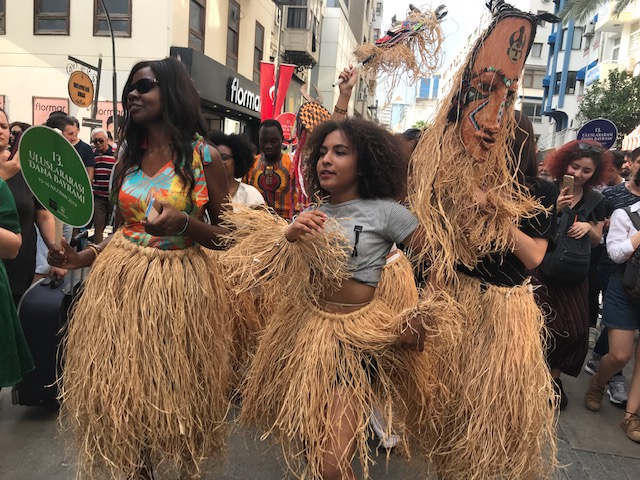
Featured photograph: Dana Bayramı procession in İzmir, 2019. The gathering included Afro-Turks, African residents from other countries and other İzmir residents. Soner Kızılkaya / VOA, via Wikimedia Commons; public domain in the United States.

In villages around İzmir, on Türkiye’s Aegean coast, Black families have lived alongside their neighbours for generations. Their histories connect Africa to the Ottoman Empire through enslavement, household service and agricultural labour. Photographer Bradley Secker’s documentation follows descendants in their homes, gardens and fields, revealing an African presence embedded in the everyday life of western Türkiye. [1]
For these communities, recovering African ancestry can involve difficult questions. What happened to the people who first arrived? Why did some families stop discussing their origins? And why might a Black person whose family has lived in Türkiye for generations still be asked where they are really from?
Slavery’s legacy inside the family
Understanding Afro-Turkish history requires looking beyond the familiar geography of Atlantic slavery. The Ottoman Empire maintained its own systems of enslavement, connecting African regions to households and workplaces across imperial territory. Black women’s domestic labour formed an important part of that system, particularly during the nineteenth century. A European Commission-supported research project identifies the neglect of this labour as a significant gap in accounts of Ottoman slavery and its relationship to modern Turkish identity. [2]
The household setting matters. When enslaved people worked inside families, their experiences could become absorbed into private domestic histories rather than preserved as a publicly acknowledged history of labour and coercion. The research project consequently treats the recovery of domestic slavery as essential to understanding how race, gender and dependence operated together. [2]
The history also reached the countryside. Secker documents agricultural communities around İzmir where enslaved Africans once cultivated crops and where descendants continue to work the land. In one family’s case, descendants now own and cultivate land behind their home. Such continuity makes slavery’s aftermath visible through particular places and family lives. [1]
Yet proximity to those places did not guarantee knowledge of the past. In interviews published by The National, some descendants described knowing neither their ancestors’ languages nor precisely where they had originated. Alev Karakartal recalled asking about her family’s appearance and receiving an answer emphasizing that they were Turkish and Muslim. She later undertook her own research into the ancestry that her family had avoided discussing. [3]
These accounts show why recovering history can be emotionally complicated. Silence may reflect shame, painful memories or a wish to protect children from difference. Descendants can inherit the consequences of enslavement while receiving only fragments of the story that explains them.
Being Turkish—and having to explain it
Türkiye’s Constitution provides a clear legal starting point. Article 10 guarantees equality before the law without distinctions including race, colour, language and religion. Black citizens fall within that protection. [4]
The more difficult question concerns everyday recognition: whom do other people instinctively understand to be Turkish?
Research published in Nationalities Papers records Afro-Turks describing questions about their origins, presumed plans to return to another country, or ability to speak Turkish fluently. These encounters can require citizens to explain an identity that others take for granted. The assumption of foreignness makes skin colour a reason to question belonging, even where legal citizenship is clear. [5]
Experiences nevertheless differ. Reporting from established villages around İzmir describes close familiarity between Black and other Turkish neighbours, alongside more uncomfortable encounters elsewhere. Someone readily accepted in a hometown may encounter disbelief in a place where Afro-Turkish history is unfamiliar. Recognition can therefore depend on local knowledge rather than a wider understanding of the country’s past. [3]
It is equally important to hear how community members describe themselves. The Nationalities Papers research finds strong commitments to Turkish identity and resistance among some interviewees to having their lives interpreted entirely through Western racial frameworks. Cultural recognition and acknowledgment of African ancestry can be sought within Turkish national belonging. Community members do not all assign the same importance to the label “Afro-Turk.” [5]
An Atlas should preserve those differences. Treating everyone as having the same relationship to ancestry would obscure the very voices that historical recovery seeks to make audible.
Dana Bayramı: turning family fragments into shared memory
Mustafa Olpak helped create a structure for that recovery. His family reached Türkiye from Crete during the population exchange between Greece and Türkiye in 1924. As Muslims, they were classified as Turks—a family history illustrating how religion, migration and national classification intersected with African ancestry. In 2006, Olpak founded an Afro-Turkish association in Ayvalık. [6]
The association’s work helped connect people whose family histories had often remained isolated. Oral-history interviews, exhibitions and public discussion created opportunities to compare experiences and preserve accounts that might otherwise disappear with older generations. Reporting describes an oral-history project interviewing approximately 100 Afro-Turks, alongside exhibitions presenting photographs and individual life stories. [6]
The revival of Dana Bayramı, or the Calf Festival, in 2007 gave that work a public gathering place. The historic celebration returned in an adapted form, with discussion and musical performance among its activities. Participants could meet other Black Turkish families, sometimes experiencing that scale of community gathering for the first time. [3]
Its value extends beyond preserving a festival. Gathering allows memories to be exchanged, relatives’ experiences to be compared and younger people to ask questions. It also makes Afro-Turkish presence visible to a broader public. Scholarship interprets the celebration as a space in which African heritage and Turkish belonging can be expressed together. [5]
The LexNoir view
The Afro-Turkish experience shows how a community can belong to a country while remaining insufficiently represented in its historical imagination.
Legal equality establishes a foundation. Family research, oral histories and cultural gatherings help people understand how that community became part of the nation—and allow descendants to decide how they describe themselves.
The larger diaspora lesson concerns the recovery of knowledge: who preserves it, whose experiences enter the record, and whether the people concerned can tell their histories in their own terms.
Sources and further reading
[1] Bradley Secker — AfroTurks
[2] European Commission — Legacies of Race and Slavery in Turkey (LERSiT)
[3] The National — Turkish descendants of African slaves begin to discover their identity
[4] Constitutional Court of Türkiye — A Brief Remark on the Two Aspects of the Principle of Equality
[6] Qantara — The Fate of the Afro-Turks: Nothing Left But the Colour