
LEXNOIR ATLAS
How descendants of Africans carried across the Indian Ocean preserve their history through family, language and the music of mānja.
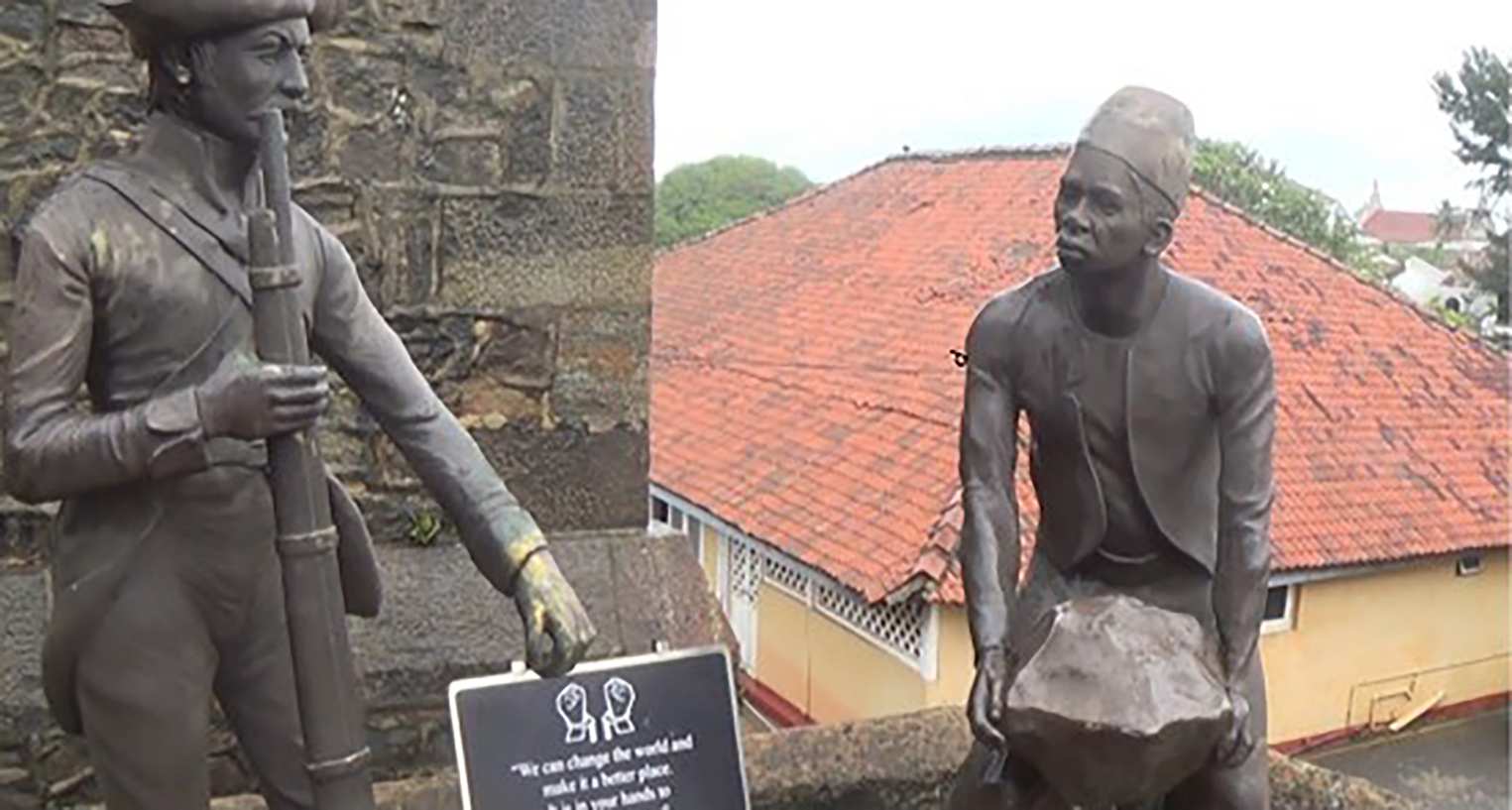
Featured photograph: sculptures of a European overseer and a labourer carrying a stone at Galle Fort, Sri Lanka—a historical memorial, rather than a photograph of the present-day Afro-Sri Lankan community. Photograph by Shihan de Silva Jayasuriya, reproduced from Figure 1 in From Plantations to Military: Heritage of Galle Fort in Sri Lanka (2025), under CC BY 4.0. Extracted from the published PDF; no substantive alteration.
Near Puttalam, on Sri Lanka’s northwestern coast, the village of Sirambiyadiya holds a history connecting Africa, European empire and South Asia. Members of its Afro-Sri Lankan community have preserved songs in a Portuguese-based creole long after that language ceased to dominate communication on the island. Their music carries an inheritance that written records only partly explain. [1]
Their story raises a question with significance across the African diaspora: when ancestral languages, places of origin and family records become difficult to recover, how does a community remember who it is?
Across the Indian Ocean: a history of several journeys
The history of Africans in Sri Lanka belongs to the wider movement of people across the Indian Ocean. Trade, military recruitment and enslavement connected African shores with South Asia through overlapping routes. European expansion entered an existing maritime world and extended the movement of people through imperial networks.
Historian Shihan de Silva Jayasuriya records community accounts describing ancestors brought to Sri Lanka as enslaved people and soldiers through Mozambique, Madagascar, Goa and Portugal. These recollections reveal journeys that could involve several ports and jurisdictions before arrival on the island. A place remembered in family history may therefore identify a point of transit rather than an ancestral homeland. [1]
That distinction matters when explaining the community’s origins. The African presence cannot be reduced to a single ship, arrival date or colonial power. Nor should the broader history of African movement be treated as exclusively involuntary: free African sailors and merchants also participated in Indian Ocean networks. Their presence forms part of the regional context, without establishing the ancestry of any particular family. [1]
Family histories also complicate the assumption that every surviving community descends directly from the Portuguese period. In a lecture published by Sri Lanka’s Lakshman Kadirgamar Institute, de Silva Jayasuriya describes an Afro-descended community whose oral history traces its ancestors’ arrival to British activity in 1817. Portuguese cultural influence and the date of a family’s arrival are separate historical questions. [2]
The surviving archive has limits. De Silva Jayasuriya’s research presentation at Yale notes that colonial records document movements of enslaved Africans while often omitting their specific ethnic and linguistic identities. Records created to administer people may preserve evidence of their transportation while telling much less about how they understood themselves. [3]
Recovering this history consequently requires several kinds of evidence: official documents, family testimony, language and cultural practice. Each answers questions that the others may leave unresolved.
Mānja: how music preserves knowledge
In Sirambiyadiya, mānja—also rendered manja, manhas or maanja in different sources—is central to that recovery.
De Silva Jayasuriya describes chant-like singing accompanied by drumming, remembered rhythms and dance. The lyrics preserve Sri Lanka Portuguese, a creole associated with the island’s colonial history. As community members shifted toward Sinhala in everyday communication, songs retained elements of a language whose ordinary spoken use had greatly diminished. [4]
The significance extends beyond retaining old words. Learning a song requires listening to another person, following its rhythm and understanding when and how to join. Knowledge passes through participation. A performance can therefore preserve relationships between generations alongside the musical material itself.
Scholar Sureshi M. Jayawardene examines mānja as a form of memory work in both private and public settings. Her research treats performance as a means through which people sustain African-descended identity and connect individual experience with collective memory. Its meaning belongs to the performers and their community, as well as to any audience watching them. [5]
Religious life adds another dimension. De Silva Jayasuriya describes the Sirambiyadiya community as Roman Catholic while also documenting an African-associated inheritance of spirits and healing traditions. This combination illustrates how descendants have maintained and adapted different cultural practices within the same community. [3]
Precision is important when discussing Sri Lankan music. Mānja should not simply be used interchangeably with kaffrinha or baila. De Silva Jayasuriya distinguishes the community’s mānja tradition from kaffrinha, an Afro-Portuguese genre with a wider and evolving history on the island. Collapsing these forms into a single category obscures what particular communities have preserved. [2, 4]
Visibility, recognition and the right to define an identity
Public performance has helped Afro-Sri Lankans reach audiences beyond their village. De Silva Jayasuriya documents mānja’s movement from community compounds into public spaces, where performances can also generate income. That creates opportunities for recognition and for practitioners to benefit from their knowledge. [4]
It also raises a question: does the audience come away understanding a community, or mainly remembering an unusual performance?
A 2020 field study by researchers K. M. N. U. Akmeemana and T. Kamalrathne examined identity in Sirambiyadiya through interviews and focus groups. The researchers argued that grouping Afro-Sri Lankans under “other” in official discourse contributed to inadequate recognition. Their findings concern that study and its participants; they should not be treated as a comprehensive account of every Afro-Sri Lankan’s experience today. [6]
Nevertheless, the study identifies a broader issue. A community can attract cultural attention while remaining poorly understood in discussions about national identity and everyday life. Being invited to perform does not necessarily create a meaningful role in deciding how one’s history is recorded, taught or presented.
The practical questions concern authority and continuity. Who selects the songs presented to visitors? Who controls recordings and accompanying explanations? Do younger people have opportunities to learn? Can practitioners shape the terms on which their heritage generates income?
These are questions for cultural institutions, researchers and audiences as well as performers. Supporting a living tradition requires sustained relationships with the people who carry it.
The LexNoir view
Afro-Sri Lankan history expands the geography of the African diaspora and the kinds of evidence through which that diaspora can be understood.
Colonial documents help trace forced movement and imperial employment. Family accounts preserve journeys and relationships that those documents may overlook. Mānja carries another form of knowledge: words, rhythms and practices maintained through people performing together.
The central responsibility is to recognize Afro-Sri Lankans as interpreters of their own inheritance. Their history deserves a place in Sri Lanka’s public understanding, and community members deserve a voice in how it is represented.
A song can carry history across generations. Its future depends on the people able—and willing—to keep teaching it.
Sources and further reading
[1] Shihan de Silva Jayasuriya — South Asia’s Africans: A Forgotten People
[2] Shihan de Silva Jayasuriya — Lecture text, Lakshman Kadirgamar Institute
[4] Shihan de Silva Jayasuriya — Lectures and seminars: Africa in Sri Lanka, Kaffrinha and Manja
[6] K. M. N. U. Akmeemana and T. Kamalrathne — Patterns and Challenges of Social Identity (2020)