

LEXNOIR ATLAS | COLOMBIA
How a community built through resistance to slavery sustains its identity through language, collective institutions and protection of ancestral land.
Launch of the multilingual cookbook Kumina ri Palenge pa tó paraje in San Basilio de Palenque. Photo: Dtokra / Wikimedia Commons, CC BY-SA 4.0.

Near Cartagena, in Colombia’s Caribbean region, San Basilio de Palenque preserves a history of freedom created by people who escaped enslavement and organized communities beyond their captors’ control. Their descendants have maintained a distinctive language and institutions governing relationships, responsibilities and collective life.
UNESCO recognized Palenque’s cultural space as a Masterpiece of the Oral and Intangible Heritage of Humanity in 2005, followed by inscription on its Representative List in 2008. That recognition encompasses a living system of language, music, knowledge and social organization. Its survival depends on people continuing to use, teach and adapt it. [1]
Palenque’s larger story concerns what happens after freedom is won: how a people sustain the relationships, territory and authority that make collective life possible.
Freedom required building a community
The word palenque refers to settlements established by people who escaped slavery. In colonial Colombia, these communities challenged the system of enslavement by creating places where fugitives could defend themselves and organize life outside the authority of enslavers.
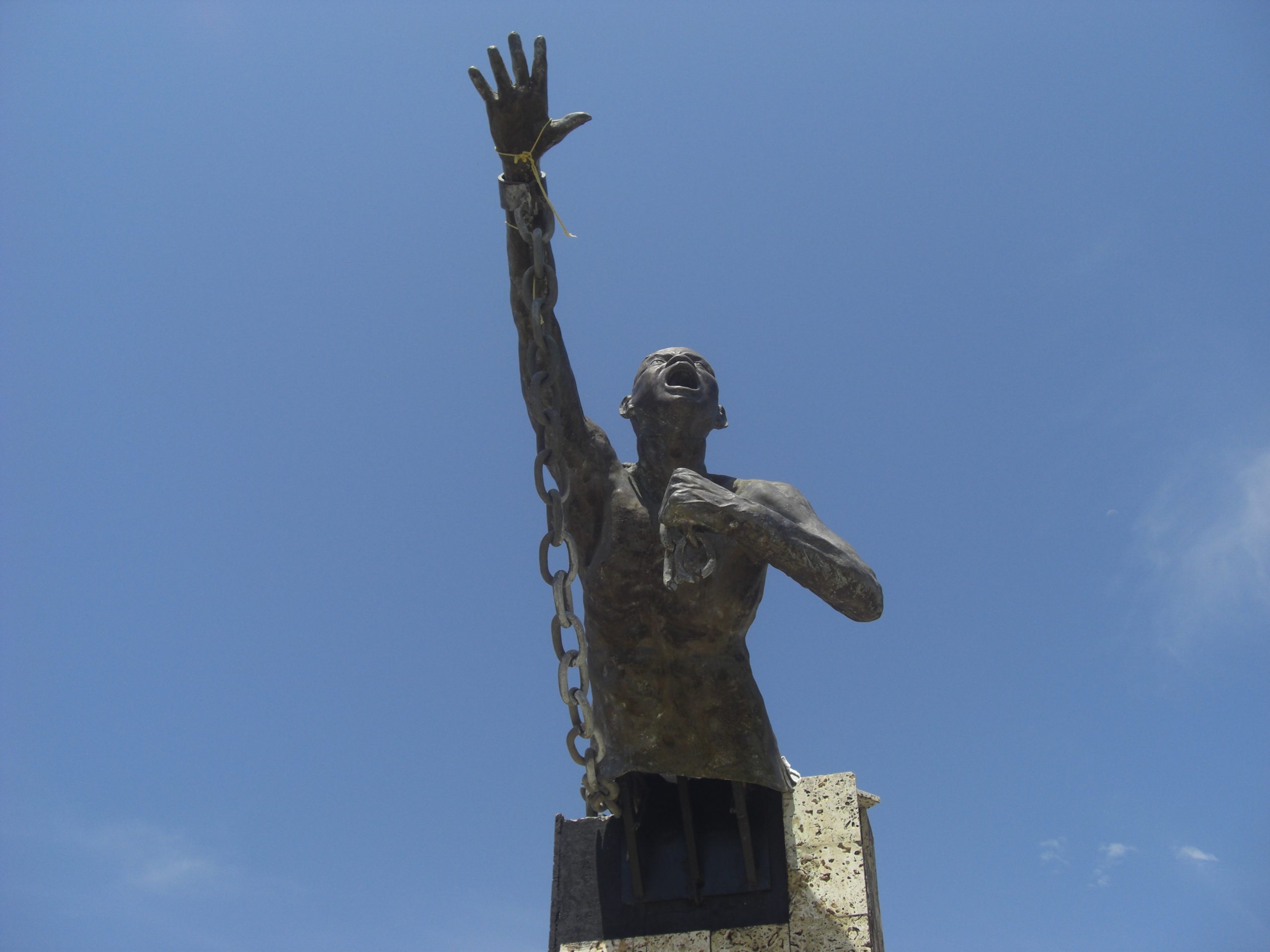
Benkos Biohó stands at the centre of Palenque’s historical memory. Captured in Africa and transported to Cartagena, he escaped with other enslaved people and became a leader of resistance in the surrounding region. Colombia’s public broadcaster, RTVC, identifies him particularly with the palenque of La Matuna. His leadership helped secure negotiated freedoms before Spanish authorities captured and executed him in Cartagena in 1621. [2]
The present community emerged through a longer history of resistance, displacement and negotiation. An account published by Bogotá’s archive identifies an agreement around 1713 as an important foundation for San Basilio’s subsequent development. Biohó’s legacy and that later agreement belong to connected stages of the struggle. [3]
Often celebrated as the “first free Black town in the Americas,” Palenque deserves attention beyond the commemorative title. Escape created an opening; maintaining freedom required people to establish durable relationships, defend their settlement and negotiate with hostile authorities.

Palenquero: a language that carries belonging
Palenquero is a creole language combining a predominantly Spanish vocabulary with grammatical features associated with Bantu languages. Colombia’s Ministry of Cultures identifies it as an essential component of Palenque’s cultural space. Its significance lies in the knowledge, relationships and ways of understanding the world that speakers transmit through it. [4]
Its survival has required deliberate work. The community’s safeguarding plan describes how encounters with discrimination outside Palenque encouraged some residents to distance themselves from their cultural practices. Declining use of the language became a central concern. The plan connects revitalization with education, community organizing and opportunities to strengthen identity among Palenqueros living elsewhere, including Cartagena and Barranquilla. [5]
Education therefore involves more than teaching vocabulary. It can change how children understand the language itself. In ministry reporting, educator Teresa Cassiani Herrera describes how ethnoeducation helped residents learn more about Africa and recognize Palenquero as a distinct language rather than defective Spanish. That shift matters: children are more likely to value an inheritance when the classroom treats it as knowledge worthy of study. [6]
Colombian law provides a supporting framework. Law 1381 of 2010 expressly includes creole languages spoken by Afro-descendant communities within its protection of native languages. Its purpose encompasses individual and collective linguistic rights, alongside the preservation, use and development of those languages. [7]
The practical challenge is turning that recognition into regular use. Lessons need teachers and materials; intergenerational transmission needs conversations at home and opportunities for young people to speak without embarrassment. A language can receive public praise while losing the everyday settings that sustain fluency.
Palenque’s safeguarding approach treats transmission as a community responsibility. The relevant question is whether younger generations can use Palenquero to participate fully in their own cultural life.
Collective life depends on relationships—and land
Palenque’s social institutions help explain how cultural continuity works. Among the most distinctive are ma-kuagro, groups organized around age relationships. Membership entails reciprocal rights and duties, solidarity and shared responsibilities. The Ministry of Cultures describes members organizing work and significant events together. These relationships provide a structure through which mutual assistance becomes an ongoing obligation.
Funeral practices offer another example. In its 2004 heritage declaration, the ministry describes lumbalú as a ritual bringing together singing, dance and percussion. Mourning becomes a collective experience, with older women playing an important role in transmitting knowledge through oral teaching and participation. The ceremony connects cultural expression with the practical work of accompanying bereaved families. [8]
These institutions require places where community life can continue. That makes land protection central to cultural survival.
In 2023, Colombia’s National Land Agency reported securing registration of the collective territory associated with the Ma Kankamaná Community Council, covering approximately 3,218 hectares and benefiting 1,500 families. The agency explained that a title resolution issued in 2012 had remained unregistered because of technical inconsistencies concerning the territory’s extent. [9]
Violence has also affected territorial continuity. In 2020, Colombia’s Land Restitution Unit reported documenting abandonment, dispossession and confinement associated with armed actors. The account records a community member linking territorial restitution with the recovery of traditional crops, medicine, music and lumbalú. [10]
That connection explains why heritage protection cannot be confined to performances or monuments. Farming, gathering medicinal plants, maintaining households and assembling for ceremonies depend on access to land and the ability to live there securely.
Palenque’s own safeguarding plan makes the relationship explicit: territory is the space in which cultural practices come together. It also identifies community autonomy and control over development as priorities. [5]
The LexNoir view
San Basilio de Palenque shows how freedom becomes durable through institutions. Resistance established the possibility of an autonomous community. Language carries knowledge between generations. Ma-kuagro and funeral practices organize care and responsibility. Territorial protection supports the conditions in which those relationships can continue.
International recognition gives Palenque visibility. Its future also depends on the authority of residents to decide how their language is taught, their heritage presented and their land used.
Palenque’s legacy is freedom sustained through collective life—and the continuing work needed to preserve the right to remain.
Sources
1. UNESCO — Cultural space of Palenque de San Basilio
2. RTVC Señal Memoria — Benkos Biohó y el Palenque de San Basilio
3. Archivo de Bogotá — Benkos Biohó en el centro de la historia afrocolombiana
4. Ministry of Cultures — Espacio cultural de San Basilio de Palenque
5. Community safeguarding plan — Plan Especial de Salvaguardia
6. Ministry of Cultures — La cultura palenquera palpita desde la música hasta las trenzas
7. Law 1381 of 2010 — Native languages and linguistic rights
8. Ministry of Culture — Resolution 1472 of 2004
9. National Land Agency — Collective territory registration, 2023
10. Land Restitution Unit — Territorial characterization, 2020