

LEXNOIR ATLAS
Haiti was born from the defeat of slavery, yet its independence came with a financial demand from the colonial power it had defeated. The country’s constitutional history links the creation of a Black republic to questions that remain urgent across the global African diaspora: who belongs, what sovereignty requires, and what justice is owed when freedom itself was made subject to a price.
Featured illustration: Jean-Jacques Dessalines, the revolutionary leader who proclaimed Haitian independence in 1804. This is a historical illustration published in 1892, not a portrait drawn from life. Source: Wikimedia Commons; public domain.

The Revolution That Changed the Meaning of Freedom
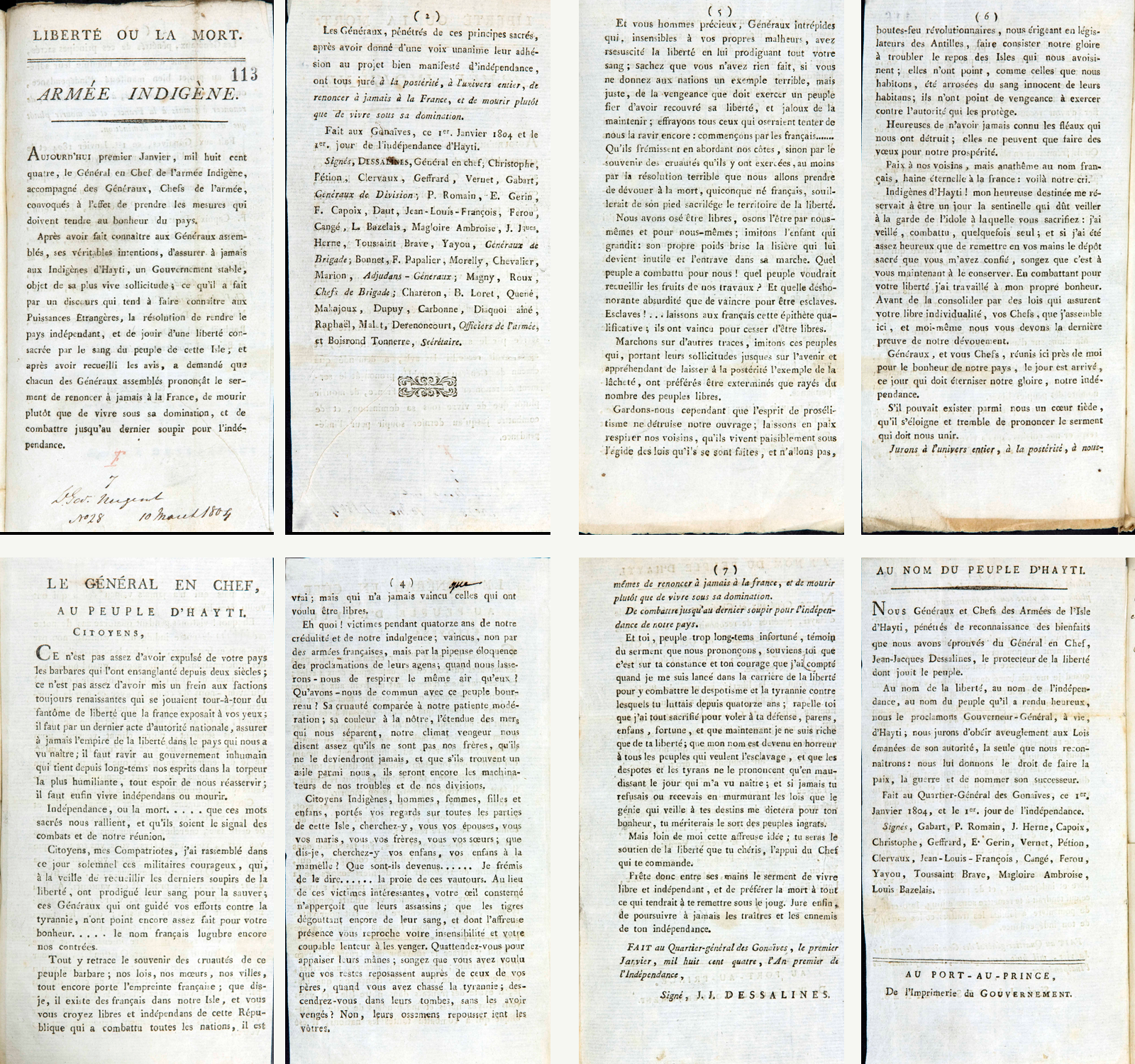
On January 1, 1804, Jean-Jacques Dessalines proclaimed Haiti’s independence from France. The new state emerged from a revolution initiated by enslaved people in the French colony of Saint-Domingue in 1791. It was not simply another colonial territory changing flags. It was the first independent state born of a successful large-scale revolt against slavery, and its existence challenged the foundations of a plantation economy that enriched Atlantic empires.
Saint-Domingue had been one of the world’s most profitable plantation colonies, producing sugar and coffee through extraordinarily violent coerced labor. Its wealth rested on a legal system that treated enslaved Africans as property. Revolutionary unrest in France opened a struggle over political rights in the colony, but enslaved people and free people of color did not wait for metropolitan authorities to decide the limits of liberty. They organized, fought, negotiated and forced the question of abolition onto the political agenda.
The uprising was neither a single event nor a movement led by one person. Toussaint Louverture became a central military and political figure; Jean-Jacques Dessalines and Henri Christophe later helped defeat the expedition sent by Napoleon Bonaparte to restore French authority. Women also sustained the revolution through resistance, intelligence, provisioning and combat, although historical accounts have not always given them equal attention. French revolutionary authorities abolished slavery in 1794, but Napoleon’s effort to reassert control in the Caribbean, including the restoration of slavery elsewhere in the French empire in 1802, made independence an urgent safeguard against re-enslavement.
The victory of 1804 transformed a demand for freedom into a claim of sovereignty. Formerly enslaved people and their descendants asserted the right not only to be free individuals but to constitute a nation. Haiti’s independence also unsettled slaveholding societies elsewhere in the Americas, where governments confronted the example of a Black republic established through armed resistance. Haiti thus became a symbol of emancipation and a target of diplomatic hostility and isolation.
The revolution’s achievements should not erase the difficulties that followed. Leaders disagreed over land, labor, military authority and the economic system that would sustain independence. The state faced internal division as well as external pressure. Those tensions make the revolution more significant, not less: it created a new political order while confronting the enormous challenge of building institutions after centuries of racial slavery.

The 1805 Constitution: Race, Citizenship and Sovereignty
Haiti’s 1805 imperial constitution translated the revolution into an unusually direct statement about race and political belonging. Article 14 declared that Haitians would be known by the general designation of “Blacks.” This was not a demographic claim that every inhabitant had the same ancestry or complexion. It was an attempt to construct a shared political identity in deliberate opposition to the racial hierarchy that had governed colonial Saint-Domingue.
Article 12 prohibited a white person from entering Haiti as a master or proprietor or acquiring property in that capacity, while Article 13 preserved exceptions for certain white women and for Germans and Poles naturalized by the government. These provisions reflected the founders’ fear that landownership and foreign influence could become instruments for the return of colonial domination. They also reveal the limits and contradictions of an early constitutional experiment that used racial categories to defend an antislavery revolution.
The document is best understood in its historical setting. Colonial law had divided people by status and color while denying enslaved Africans legal personhood. The new constitutional order sought to reverse the political meaning of Blackness, making it a sign of collective citizenship rather than subordination. At the same time, its exclusions and strong concentration of power resist easy description in the language of modern universal equality.
Constitutional identity and political practice did not remain fixed. Haiti experienced changes of government, territorial division and reunification, and successive constitutions. Yet the 1805 text remains an extraordinary document for comparative constitutional history. It raises questions that recur throughout the diaspora: Can a people emerging from racial oppression construct solidarity through a shared political identity? How should a state guard against the return of domination without reproducing unjust exclusions? And who has the authority to define membership in a newly independent nation?
These are not merely historical questions. They help explain why Haitian independence occupies a distinctive place in debates about race, national sovereignty, citizenship and reparative justice.
The Independence Indemnity: When Recognition Had a Price
Although Haiti had secured independence in 1804, France did not formally recognize it for more than two decades. On April 17, 1825, King Charles X issued an ordinance conditioning recognition on extraordinary financial concessions. Haiti was required to pay 150 million francs in five annual installments, intended to compensate former French colonists for property lost with independence. The ordinance also granted preferential customs treatment to French commerce.
The political setting matters. French warships approached Haiti, and the threat of military coercion shaped President Jean-Pierre Boyer’s acceptance of the terms. The legal form was a royal ordinance, but the transaction cannot be understood as an ordinary bargain between equal parties. Haiti was being asked to pay former enslavers and colonial proprietors for the consequences of the very revolution that had ended their control.
The financial burden was immense relative to Haiti’s resources. To make the first payment, the government borrowed from French lenders, incurring interest and fees. In 1838, a new agreement reduced the original indemnity obligation from 150 million to 90 million francs overall and extended the payment schedule. The loan obligations and indemnity together produced what historians call Haiti’s “double debt.” It is important to distinguish the original nominal indemnity, the renegotiated obligation, interest and banking charges; they are not interchangeable figures.
Payments and debt service constrained the state’s fiscal choices across generations. The scale of the damage cannot be reduced to a single uncontested modern-dollar estimate, and Haiti’s subsequent economic and political history had multiple causes. But the documentary record establishes a stark inversion of responsibility: a nation created by emancipating enslaved people was made to transfer wealth to interests associated with the former slaveholding regime.
The indemnity is therefore central to contemporary reparations debates. It raises a different question from the general moral claim that slavery was wrong: whether a state that extracted compensation under coercive conditions should now provide restitution, compensation or other forms of repair. Answering that question requires historical accounting, legal analysis, attention to the passage of time and consideration of who would receive and administer any remedy.
On the bicentenary of the ordinance in April 2025, French President Emmanuel Macron acknowledged the heavy burden imposed on Haiti and announced a joint French-Haitian historians’ commission to examine the shared past, including the indemnity’s impact. The announcement represented a step toward official historical examination; it did not itself establish a legally enforceable reparations obligation or announce repayment. The distinction between recognition, historical inquiry and concrete remedy remains crucial.
The Diaspora and the Legal Meaning of Haitian Belonging
Haiti’s influence extends well beyond its borders. Haitian communities in the United States, Canada, the Dominican Republic, France and elsewhere sustain connections through families, remittances, business, culture and political engagement. For a country whose independence helped redefine Black freedom, the law of nationality has become an important measure of whether that broader community can participate in the nation’s future.
Under Article 11 of Haiti’s constitution, nationality by descent is tied to having a Haitian father or mother who is a native-born Haitian and has not renounced Haitian nationality. The precise legal rules matter because cultural identity, family ancestry, citizenship and the right to hold public office are not identical. A person may be deeply connected to Haiti while facing documentary or legal obstacles to exercising particular rights.
The original 1987 Constitution prohibited dual Haitian and foreign nationality. Constitutional amendments promulgated in June 2012 removed that prohibition and revised the nationality framework. The change opened a more accommodating relationship with Haitians living abroad, but it did not automatically resolve every case involving earlier loss of nationality, proof of descent or eligibility for public office. Implementation and applicable laws remain important, and the constitution retains distinctions for certain rights and positions.
These issues are practical rather than symbolic alone. Nationality affects the ability to obtain documents, own or inherit property subject to applicable rules, participate in elections and hold public responsibilities. It also shapes how families separated by migration understand their obligations to the country. A diaspora may be economically essential and culturally influential while lacking straightforward access to political participation.
Haiti’s constitutional history thus presents two connected visions of belonging. The revolutionary generation used law to protect a nation formed against slavery and foreign domination. The modern state must also determine how to include descendants living abroad without abandoning democratic accountability at home. That balance is especially consequential where migration has dispersed families across generations.
Neither a romantic account of the revolution nor a crisis-only portrait of present-day Haiti captures the full story. Haiti is a society of institutions, intellectual traditions, artists, lawyers, entrepreneurs and communities whose claims to sovereignty and rights continue to evolve. Its diaspora is part of that ongoing national history, not simply an audience watching from outside.
Atlas Perspective
Haiti’s revolutionary achievement cannot be understood apart from the price later imposed for international recognition. The 1805 Constitution shows how a new nation sought to turn racial subordination into a shared claim to citizenship; the 1825 indemnity shows how an old colonial power used financial coercion to constrain that sovereignty. The 2012 nationality reforms reveal a third dimension: the continuing task of defining membership in a nation with a far-reaching diaspora.
For LexNoir, Haiti is not simply a historical symbol or a contemporary humanitarian headline. It is a foundational case study in Black constitutionalism, economic redress and the unfinished work of turning independence into meaningful self-determination.
Sources and Further Reading
UNESCO — National History Park: Citadel, Sans-Souci and Ramiers
1805 Constitution of Haiti — historical text
French Foundation for the Memory of Slavery — Ordinance of April 17, 1825
Bibliothèque nationale de France — Haiti’s Independence Debt
Presidency of France — April 17, 2025 statement on Haiti
Haiti’s Constitution (1987, amended through 2012)
Immigration and Refugee Board of Canada — Haitian dual nationality reforms