

LEXNOIR ATLAS
The Afro-Bolivians of the Yungas: historical memory, cultural survival, a ceremonial monarchy, and constitutional recognition.
Featured photograph: Afro-Bolivian saya dancer in Coroico. CLAUDIOLD, Wikimedia Commons, CC BY-SA 4.0. Automatically resized by WordPress; no other intentional alteration.

High in Bolivia’s Andean foothills, where tropical forests descend toward the Amazon basin, lives a community whose history connects Africa, the Spanish colonial empire, and one of South America’s most remarkable surviving cultural traditions.
The Afro-Bolivians of the Yungas are descendants of Africans brought to colonial South America through the transatlantic slave trade. Over generations, they established communities, preserved distinctive musical traditions, and maintained an extraordinary institution: a hereditary African-descended ceremonial monarchy.
Their history is not simply one of survival. It is also a story of cultural reinvention, political mobilization, and the long struggle to secure recognition within a country that historically defined its identity principally through its Indigenous and European heritage.
From the Silver Mines to the Yungas
The African presence in Bolivia dates to the Spanish colonial period, when the territory formed part of the Viceroyalty of Peru and later the Viceroyalty of the Río de la Plata.
Enslaved Africans were transported into the region through colonial trading networks and compelled to labor in mining, domestic service, agriculture, and other occupations.
The silver mines of Potosí, among the most important sources of wealth for the Spanish Empire, became closely associated with the exploitation of Indigenous labor. Enslaved Africans also worked within the colonial economy, although their roles and numbers varied over time.
Over successive generations, substantial African-descended communities developed in the Yungas, a subtropical region northeast of La Paz.
The area’s warmer climate and agricultural estates offered different economic conditions from the high-altitude mining centers. Enslaved Africans and their descendants worked on haciendas producing coca, coffee, and other crops.
Communities developed around settlements including Tocaña, Mururata, and Chijchipa.
Following Bolivia’s independence in 1825, slavery did not immediately disappear from social and economic life. Although independence-era measures challenged enslavement, its formal abolition came in 1851.
Even after emancipation, Afro-Bolivian agricultural workers remained subject to unequal landholding arrangements and other forms of economic dependency.
The Yungas nevertheless became a center of Afro-Bolivian community life, where families preserved cultural practices and collective memories that would eventually support a broader movement for recognition.
Saya: Music as Cultural Memory and Political Expression
One of the most distinctive features of Afro-Bolivian identity is saya, a musical and dance tradition rooted in the Yungas.
Saya combines drumming, singing, and coordinated movement. Performances frequently involve call-and-response vocals, with percussion providing the underlying rhythm.
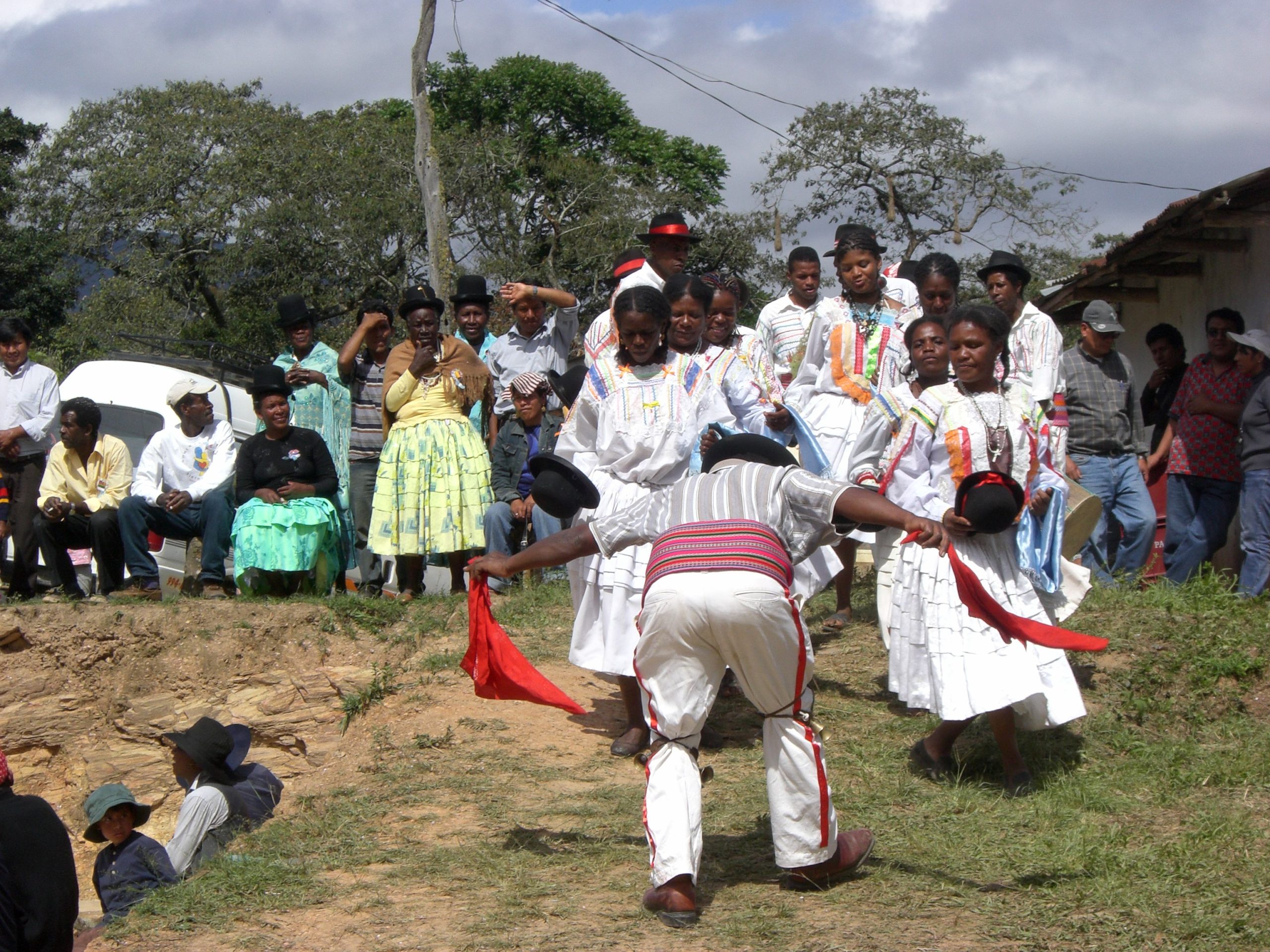

The tradition is more than entertainment. Its songs communicate collective memory, community experiences, social commentary, and assertions of African-descended identity.
For generations, saya helped preserve a recognizable cultural inheritance within communities whose ancestors had experienced forced migration and whose daily languages and institutions became integrated into Bolivian society.
During the twentieth century, Afro-Bolivian cultural organizations increasingly presented saya beyond the Yungas, including in La Paz.
These performances challenged a national narrative in which Black Bolivians had frequently been overlooked.
They also generated debate about cultural ownership. As Afro-Bolivian rhythms attracted wider audiences, elements of their musical heritage were incorporated into popular Bolivian performance traditions, sometimes without sufficiently acknowledging their origins.
Afro-Bolivian activists worked to distinguish traditional saya from related commercial musical forms and to establish community recognition of its history.
Those efforts produced a significant legal achievement.
In 2011, Bolivia enacted Law No. 138, declaring Saya Afroboliviana part of the country’s historical, cultural, and intangible heritage. The legislation specifically recognized the Yungas as the tradition’s birthplace.
A subsequent law in 2024 established June 29 as the annual national day celebrating this living cultural expression.
The recognition illustrates how a musical tradition can become the foundation for broader claims involving cultural identity, public acknowledgment, and community ownership.
For Afro-Bolivians, saya is both a reminder of the past and an instrument through which successive generations assert their place in Bolivia’s future.
The King of the Afro-Bolivians
Perhaps the most unusual institution preserved by the Afro-Bolivian community is its hereditary ceremonial monarchy.
Centered in Mururata, the tradition traces its origins to oral histories concerning Uchicho, an enslaved African believed by community members to have possessed royal ancestry.
Accounts of the monarchy’s earliest history vary, and the precise African origins and succession of its first leaders are difficult to establish independently.
Nevertheless, the tradition endured through generations of the Pinedo family.
Its best-known contemporary representative is Julio Pinedo, who was recognized by members of the Afro-Bolivian community as king in 1992.
In 2007, authorities in the department of La Paz publicly recognized his ceremonial position.
Unlike the constitutional monarchies of Europe, the Afro-Bolivian monarchy exercises no sovereign governmental authority. Bolivia remains a republic, and its elected institutions retain political power.
The king’s significance lies instead in cultural leadership, historical continuity, and the preservation of a community institution that survived enslavement, emancipation, and profound social change.
Julio Pinedo has also attracted international attention because of the contrast between his title and his everyday life in the Yungas, where he has maintained close connections to agricultural and community life.
The monarchy represents something unusual in the history of the African diaspora.
While the forced transportation of Africans to the Americas disrupted political institutions and family relationships, the Afro-Bolivian community preserved a tradition of royal leadership within a society far removed from its ancestral origins.
The institution’s importance therefore extends beyond ceremony. It reflects a community’s determination to retain and reinterpret an African inheritance within its own evolving identity.
From Invisibility to Constitutional Recognition
For much of Bolivia’s modern history, Afro-Bolivians occupied a marginal position within official discussions of national identity.
Although the country celebrated Indigenous traditions and its mixed European and Indigenous heritage, African-descended communities received considerably less attention.
Afro-Bolivian organizations responded through cultural advocacy, political mobilization, and demands for recognition in national institutions.
A major turning point came with Bolivia’s 2009 Constitution.
Article 3 expressly includes Afro-Bolivian communities within the Bolivian nation.
More importantly, Article 32 extends to the Afro-Bolivian people, where applicable, the economic, social, political, and cultural rights recognized for Indigenous nations and peoples.
The Constitution also provides protections concerning the cultural knowledge and intellectual property of Afro-Bolivian communities.
This represented an important transformation in the community’s legal status: Afro-Bolivians were no longer merely a historically present population seeking cultural acknowledgment. Their identity and rights were expressly recognized in the country’s constitutional framework.
The recognition was followed by additional cultural measures, including the establishment of September 23 as the National Day of the Afro-Bolivian People and Culture.
Census recognition has also contributed to the community’s visibility.
Bolivia’s 2012 census recorded approximately 23,330 people identifying as Afro-Bolivian. Subsequent census reporting confirms the continued importance of self-identification, although population counts must be interpreted in light of census methodology and the willingness of individuals to identify with a particular group.
Legal recognition, however, does not by itself guarantee equality.
Afro-Bolivian advocates continue to identify challenges involving discrimination, economic opportunity, education, and participation in public life.
The community’s experience illustrates a recurring issue across the African diaspora: the distance between formal recognition of collective identity and the practical realization of equal citizenship.
LexNoir Perspective
The Afro-Bolivian experience offers a particularly compelling example of how African-descended communities have preserved and transformed their identities across centuries.
Three developments distinguish this history.
First, saya demonstrates that cultural practices can serve as instruments of political recognition. What began as a community tradition eventually became part of a national legal framework protecting cultural heritage.
Second, the Afro-Bolivian monarchy illustrates how institutions associated with African political identity could survive displacement, acquiring new meaning within the Americas.
Third, Bolivia’s constitutional recognition of Afro-Bolivians offers an important comparative example for governments confronting questions of historical exclusion, minority rights, and cultural protection.
Yet the most significant lesson may concern the relationship between recognition and opportunity.
A community may secure constitutional acknowledgment, national cultural celebrations, and international attention while still confronting barriers to economic and political participation.
For LexNoir, the Afro-Bolivian story is therefore both a remarkable example of cultural continuity and a reminder that meaningful inclusion requires more than acknowledgment.
The African diaspora is not defined only by the places to which Africans were taken. It is also defined by the institutions, traditions, and communities their descendants built—and continue to shape.
Sources and Further Reading
- Constitution of the Plurinational State of Bolivia (2009), arts. 3, 32 and 100.
- Bolivian Law No. 138 (2011), Saya Afroboliviana cultural heritage.
- Bolivian Law No. 200 (2011), National Day of the Afro-Bolivian People and Culture.
- Bolivian Law No. 1559 (2024), national day celebrating Saya Afroboliviana.
- Instituto Nacional de Estadística de Bolivia, population censuses (2012 and 2024).
- Organization of American States, RIAFRO study (2025).
- Associated Press reporting on Afro-Bolivian identity and cultural heritage (2025).