
What Happened
South Africa’s Department of Home Affairs announced on 9 October 2026 that it had withdrawn a directive issued on 28 September to Refugee Reception Offices concerning the intake of asylum applications. The directive was intended to implement a 7 July Constitutional Court judgment in Scalabrini Centre of Cape Town and Another v Minister of Home Affairs and Others, [2026] ZACC 30.
In that unanimous decision, the Constitutional Court confirmed that sections 4(1)(f), 4(1)(h), 4(1)(i) and 21(1B) of the Refugees Act were unconstitutional. The provisions created procedural barriers that could prevent people from having asylum claims assessed on their merits because they entered South Africa irregularly, lacked an asylum transit visa or missed reporting requirements. The Court emphasized the principle of non-refoulement: people must not be returned to circumstances where they face persecution or other qualifying serious harm without the protection of a lawful asylum determination process.
Home Affairs says implementation of the September directive rapidly overwhelmed reception offices, endangered staff and generated public-safety concerns. The withdrawal followed violent anti-migrant protests in Johannesburg’s Soweto township and Durban, where vehicles were burned and foreign-owned businesses looted. Authorities also warned that misinformation had falsely portrayed the judgment as granting undocumented migrants automatic legal status.
The distinction is critical: Home Affairs withdrew its operational directive, not the Constitutional Court’s judgment. The department says it will develop a new approach that complies with the Court’s order. The ruling does not automatically confer refugee status, permanent residence or an unconditional right to remain in South Africa; individual claims still require assessment under applicable law.
Why It Matters
The dispute places two constitutional obligations in direct public view: the state’s responsibility to administer immigration and maintain public order, and its obligation to provide lawful access to refugee protection. Administrative pressures do not, by themselves, undo a binding judgment. Whether the government can implement the decision without renewed delays or barriers will be a consequential test of South Africa’s rule of law.
The implications extend beyond South Africa. Migrants and asylum seekers from elsewhere in Africa may depend on access to a fair procedure before removal. Violence against foreign nationals adds a separate threat to their security and livelihoods, while misinformation can turn a technical legal ruling into a flashpoint for xenophobia. The judgment also has wider relevance to countries balancing border enforcement with the international prohibition on refoulement.
LexNoir View
This is not a judicial instruction to grant asylum indiscriminately. It is a constitutional requirement that the government not close the door to protection claims solely because of procedural noncompliance. South Africa can scrutinize applications, investigate fraud and enforce immigration laws while still honoring that requirement.
The next issue is implementation. Home Affairs must explain what replaces the withdrawn directive, how applicants can lodge claims in the interim, and what measures will protect both reception-office staff and migrants facing intimidation. LexNoir will follow whether the revised approach preserves the substance of the Constitutional Court’s ruling and whether authorities hold perpetrators of anti-migrant violence accountable.
Sources
- Constitutional Court of South Africa, Scalabrini Centre, [2026] ZACC 30 (7 July 2026)
- Department of Home Affairs, withdrawal of asylum directive (9 October 2026)
- Inter-Ministerial Committee on Migration, briefing on asylum judgment and operations (8 October 2026)
- Department of Home Affairs, statement on disinformation (7 October 2026)
- Reuters, reporting on directive withdrawal and violence (9 October 2026)
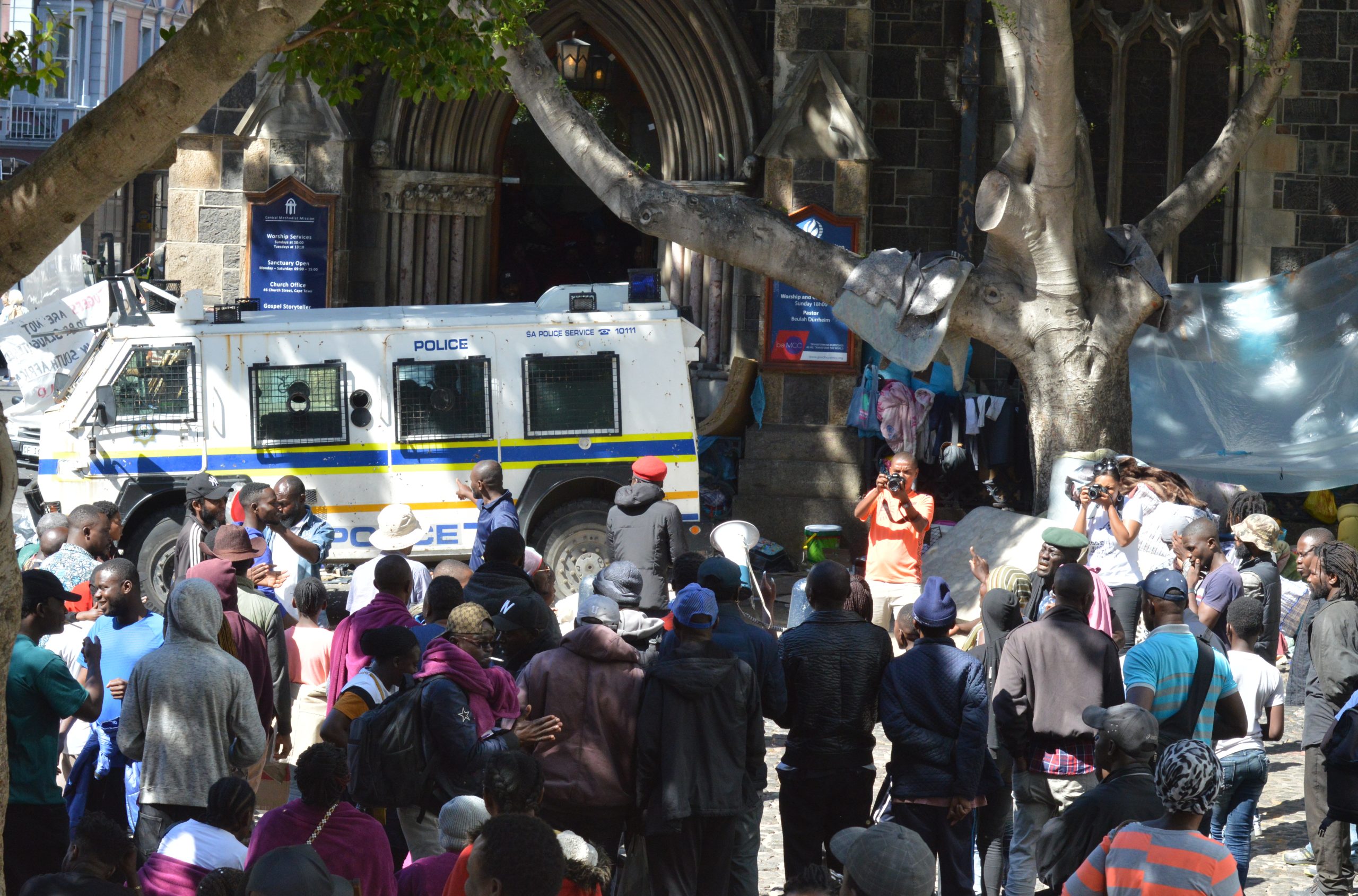
Featured photograph (archival, December 2019): Refugees at a sit-in protest in Cape Town. Discott / Wikimedia Commons, CC BY-SA 4.0. The photograph does not depict the October 2026 events. Changes, including cropping, must be indicated and the applicable ShareAlike terms observed.
