

Welket Bungué, a Guinea-Bissau-born Portuguese actor and filmmaker whose work explores migration, identity and belonging. His career reflects the contributions of African-descended artists to contemporary Portuguese culture. Photograph: Martin Kraft, 2017. Licensed under CC BY-SA 3.0.

LEXNOIR ATLAS
Portugal’s Black history is inseparable from the history of its empire—but it cannot be confined to that history. African people have lived in Portugal for centuries, while modern Afro-Portuguese communities have helped redefine citizenship, culture and public life. The central questions are how Portugal confronts the human consequences of slavery and colonialism, and whether its promises of equality translate into genuine belonging.
Black Portugal: A History Older Than Immigration
Black Portuguese identity cannot be explained solely by recent migration. African people lived in Portugal centuries before the modern republic, including free and enslaved people who worked in households, ports, trades and urban communities. From the fifteenth century, Portuguese maritime expansion linked Lisbon and other ports to trading networks along the African coast and eventually to Brazil and the Atlantic plantation economy. The lives of Africans in Portugal were shaped by enslavement, commerce, religion, family formation and resistance. Their presence is part of Portuguese history, not merely a consequence of immigration in the late twentieth century.
Today, Black people in Portugal include Portuguese citizens whose families have lived in the country for generations, people with roots in Angola, Cabo Verde, Guinea-Bissau, Mozambique and São Tomé and Príncipe, and residents connected to Brazil and other parts of the African diaspora. They do not share a single national origin, migration experience or preferred identity. The terms negros, afrodescendentes and afro-portugueses overlap but are not interchangeable.
Portugal’s official statistics illustrate why terminology matters. In August 2025, Statistics Portugal (INE) reported that its 2023 survey estimated 462,400 Afro-descendants aged 18–74, or 6.1% of residents in that age group. This was an ancestry-based estimate, not a census count of all Black residents: respondents’ self-described ethnic identities varied, and children under 18 and adults over 74 were outside the reported population. INE also found that approximately 31.7% of Afro-descendant respondents reported experiencing discrimination. These findings offer important evidence, but they should not be presented as a complete national Black population count.

Empire, Enslavement and the Meaning of Abolition
Portugal was a major participant in the Atlantic trafficking of enslaved Africans. Its merchants, officials and colonial institutions helped build routes connecting African societies with the Americas, particularly Brazil. Enslaved people were forcibly removed from their homes, separated from families, transported in lethal conditions and compelled to work under systems that denied their autonomy. The profits and institutions of slavery formed part of the economic and political history of the Portuguese empire.
The legal history of abolition is frequently oversimplified. A royal measure in 1761 restricted the importation of enslaved people into metropolitan Portugal; a 1773 measure moved toward ending hereditary slavery there. Neither ended slavery across the empire. In 1836, Portugal adopted a measure prohibiting the export of enslaved people from its dominions. The decree of 25 February 1869 abolished the legal status of slavery throughout the monarchy, but it converted enslaved people in overseas territories into a category of libertos—nominally freed persons still subject to legal constraints. Subsequent measures formally ended that condition, with public tutelage continuing in some form until 1878.
Portugal’s own parliament emphasizes that abolition was a prolonged, uneven process rather than a single liberating event. That distinction matters because celebrating an early metropolitan decree as the end of Portuguese slavery erases the people who remained enslaved in overseas territories for generations. It also obscures the continuation of coercive colonial labor arrangements after formal abolition. The appropriate historical question is not only when slavery was prohibited on paper, but when people actually acquired control over their labor, movement and family lives.
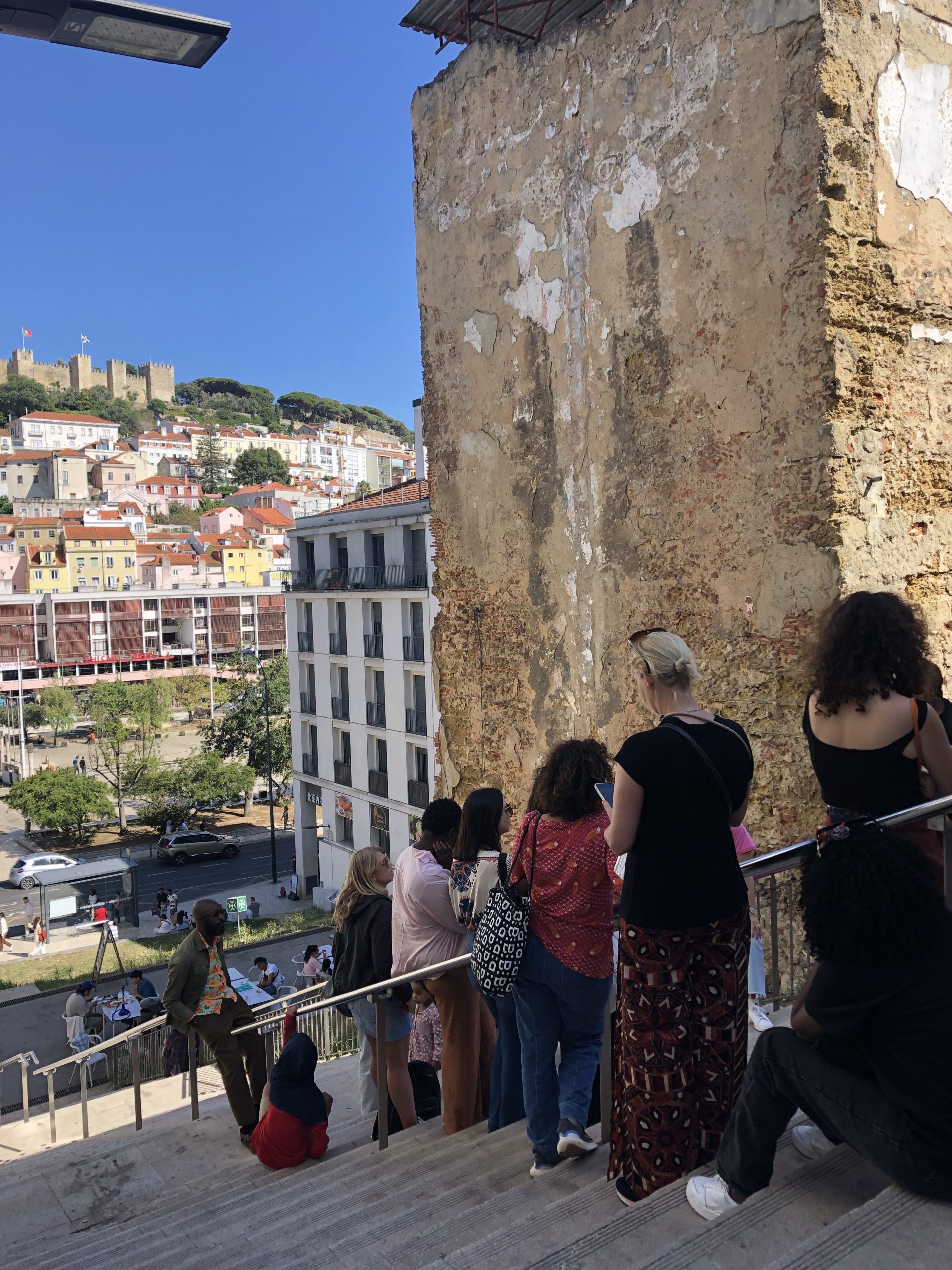
That history remains visible in the geography and memory of Lisbon, even where public monuments long emphasized maritime exploration rather than the people subjected to the empire’s violence. The recovery of Black Portuguese history requires attention to those whose lives were excluded from celebratory accounts of the so-called Age of Discoveries.
The End of Empire: Independence, Citizenship and Belonging
Portugal’s authoritarian Estado Novo regime maintained colonial rule in Africa well into the twentieth century. Armed liberation struggles began in the early 1960s in territories including Angola, Guinea-Bissau and Mozambique. Colonial warfare, repression and the demands of African independence movements placed mounting pressure on the Portuguese state. The Carnation Revolution of 25 April 1974 overthrew the dictatorship and accelerated decolonization. Angola, Mozambique, Cabo Verde and São Tomé and Príncipe became independent in 1975; Guinea-Bissau had declared independence in 1973, which Portugal recognized in 1974.
Independence did not produce a simple transition from colonial subjects to equal members of a new postcolonial community. Portugal’s Decree-Law 308-A/75, adopted in June 1975, redrew nationality rules as colonial territories became independent. The measure preserved Portuguese nationality for certain categories, including some people born in metropolitan Portugal or with qualifying family or residence ties, but many people previously classified as Portuguese nationals through the empire lost that status. The rules created sharply different outcomes for families with similar lived connections to Portugal.
This legal transition shaped the position of people arriving from former colonies, including African families whose residence, employment and children’s future depended on nationality and immigration status. Later migration and family reunification further diversified Portuguese society. The broader lesson is that formal decolonization did not automatically resolve the question of who belonged to Portugal. The state could relinquish imperial control while retaining legal distinctions that affected people whose lives had been bound together by that empire.
Contemporary Black Portuguese life is also much more than the aftermath of colonialism. Afro-descendant communities have helped shape Portugal’s literature, music, journalism, education, sport, civic institutions and political debates. The significance of this contribution is that Black people are not simply subjects of Portugal’s historical responsibility; they are participants in defining its present and future.
Equality in Law and the Evidence of Discrimination
Article 13 of the Portuguese Constitution establishes equality before the law and prohibits discrimination on grounds including ancestry, race, language and territory of origin. Law No. 93/2017 establishes a statutory regime for preventing and combating discrimination based on racial or ethnic origin, color, nationality, ancestry and territory of origin. Law No. 3/2024 created a new, independent Commission for Equality and Against Racial Discrimination (Comissão para a Igualdade e Contra a Discriminação Racial, CICDR), operating alongside Portugal’s parliament.
These protections are important, but their practical value depends on access to complaints procedures, investigation, evidence, remedies and institutional resources. The European Commission against Racism and Intolerance (ECRI), in its sixth report on Portugal published in June 2025, raised concerns about racist hate speech, inadequate equality data, racial profiling and reports of discriminatory police conduct. It urged stronger independent assessment of policing practices and sustained dialogue with affected communities. The report also called for adequate resources for the new equality body.
The gap between formal equality and lived experience is particularly evident where discrimination affects housing, employment, schools or encounters with law enforcement. The INE survey offers a rare official statistical window into reported discrimination among Afro-descendant residents, while the ECRI report identifies institutional weaknesses that can make those experiences difficult to remedy. Neither source supports treating every Afro-descendant resident as having the same experience; both show why policymakers need better data and functioning enforcement mechanisms.
Community advocacy has been central to making these issues visible. SOS Racismo, established in 1990, has challenged racist violence and discrimination through public education and activism. Djass — Associação de Afrodescendentes has linked contemporary equality demands to recognition of slavery and its continuing legacy. Their work illustrates the role of Afro-descendant organizations in shaping the public record rather than waiting for official institutions to define it.
Colonial Memory, Reparations and Who Tells the Story
Portugal’s debate over colonial memory concerns more than the language used in museums or schoolbooks. It asks whether the country can recognize African resistance, the experiences of enslaved people and the violence of colonial rule alongside narratives of navigation, trade and cultural exchange. The question has consequences for education, public monuments, historical research and the relationship between Portugal and the countries once under its control.
One concrete example is Djass’s proposal for a memorial in Lisbon honoring enslaved people. The project emerged through a participatory-budget initiative selected in 2017 and seeks to acknowledge the people trafficked and enslaved under Portuguese rule. Its importance lies not only in the monument itself, but in the claim that descendants and affected communities should help decide how this history is publicly remembered.
Debate over reparations has likewise exposed different understandings of responsibility. In April 2024, President Marcelo Rebelo de Sousa publicly suggested that Portugal should assume responsibility for colonial and slavery-era harms and consider forms of redress. The Portuguese government responded that it had no specific reparations process or program under consideration, while emphasizing historical recognition and cooperation with former colonies. Those positions should not be collapsed into a claim that Portugal adopted a national reparations policy.
Reparatory justice can involve questions of acknowledgment, historical truth, return of cultural property, educational reform, direct remedies and economic commitments. Different affected communities may favor different approaches. The essential issue for a credible process is whether people whose ancestors experienced enslavement and colonial domination can participate meaningfully in deciding what recognition and repair should entail.
Atlas Perspective
Portugal presents a revealing tension for the global African diaspora: a country can celebrate centuries of cultural connection with Africa while leaving the coercion and racial hierarchies of empire insufficiently examined. The legal history of abolition, the citizenship rules that followed decolonization, and contemporary evidence of discrimination all demonstrate that recognition is meaningful only when it changes whose histories are told, whose rights are enforceable, and whose voices shape national decisions.
The Afro-Portuguese experience also illustrates why diaspora history cannot end with victimhood. Black residents and citizens have shaped Portuguese society across generations and are active participants in debates over equality, public memory and the meaning of belonging.
Featured photograph: Welket Bungué at the 2017 Berlin International Film Festival. Photograph by Martin Kraft, Wikimedia Commons, licensed under CC BY-SA 3.0. Image may be cropped for display.
Sources and Further Reading
Statistics Portugal (INE) — Afro-descendant population and discrimination, 2023 survey (released 2025)
Portuguese Parliament — 150 years of abolition in the Portuguese empire
National Archive, Torre do Tombo — Abolition of the slave trade
Cambridge University Press — Post-imperial migration and nationality in Portugal
Portuguese Constitution, Article 13 (Diário da República)
Law No. 93/2017 — Consolidated anti-discrimination legislation
Law No. 3/2024 — Independent Commission for Equality and Against Racial Discrimination
Council of Europe ECRI — Sixth report on Portugal (2025)
Government of Portugal — Statement on colonial reparations (27 April 2024)
Djass — Memorial to enslaved people
SOS Racismo — Organization and advocacy